
Bên cạnh Hướng dẫn đề thi IELTS 21/11/2020 bài WRITING TASK 1 (map) về school library (kèm bài sửa cho HS đi thi), IELTS TUTOR Giải đề "Describe a time you watched a famous person being interviewed." IELTS SPEAKING
I. Đề bài
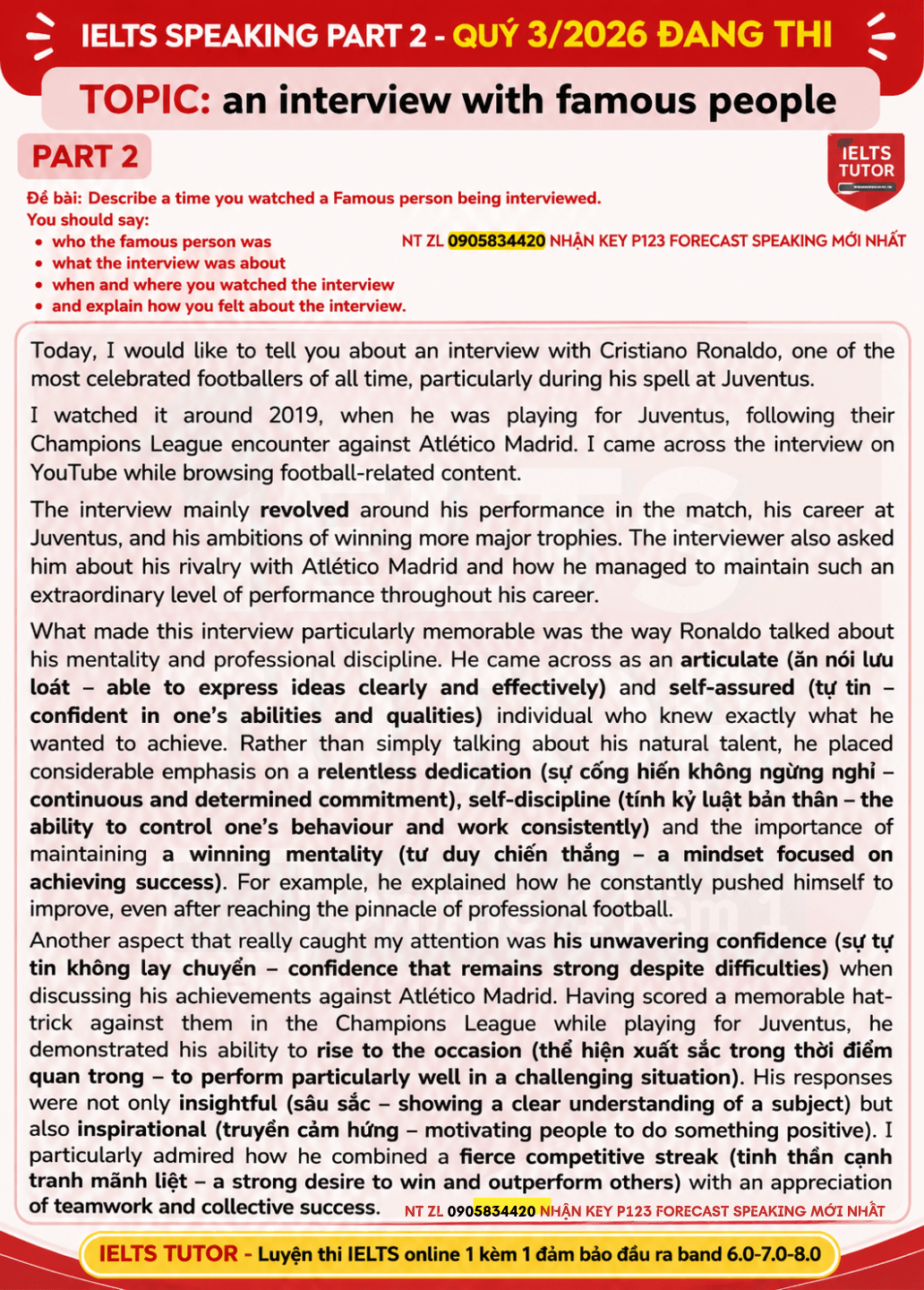
Đề bài: Describe a time you watched a famous person being interviewed.
You should say:
- who the famous person was
- what the interview was about
- when and where you watched the interview
- and explain how you felt about the interview.
II. Kiến thức liên quan
IELTS TUTOR tổng hợp Từ vựng tả người dạng Describe a person ...
III. Phân tích
IELTS TUTOR gợi ý bài tham khảo:
Today, I would like to tell you about an interview with Cristiano Ronaldo, one of the most celebrated footballers of all time, particularly during his spell at Juventus.
I watched it around 2019, when he was playing for Juventus, following their Champions League encounter against Atlético Madrid. I came across the interview on YouTube while browsing football-related content.
The interview mainly revolved around his performance in the match, his career at Juventus, and his ambitions of winning more major trophies. The interviewer also asked him about his rivalry with Atlético Madrid and how he managed to maintain such an extraordinary level of performance throughout his career.
What made this interview particularly memorable was the way Ronaldo talked about his mentality and professional discipline. He came across as an articulate (ăn nói lưu loát – able to express ideas clearly and effectively) and self-assured (tự tin – confident in one's abilities and qualities) individual who knew exactly what he wanted to achieve. Rather than simply talking about his natural talent, he placed considerable emphasis on relentless dedication (sự cống hiến không ngừng nghỉ – continuous and determined commitment), self-discipline (tính kỷ luật bản thân – the ability to control one's behaviour and work consistently) and the importance of maintaining a winning mentality (tư duy chiến thắng – a mindset focused on achieving success). For example, he explained how he constantly pushed himself to improve, even after reaching the pinnacle of professional football.
Another aspect that really caught my attention was his unwavering confidence (sự tự tin không lay chuyển – confidence that remains strong despite difficulties) when discussing his achievements against Atlético Madrid. Having scored a memorable hat-trick against them in the Champions League while playing for Juventus, he demonstrated his ability to rise to the occasion (thể hiện xuất sắc trong thời điểm quan trọng – to perform particularly well in a challenging situation). His responses were not only insightful (sâu sắc – showing a clear understanding of a subject) but also inspirational (truyền cảm hứng – motivating people to do something positive). I particularly admired how he combined a fierce competitive streak (tinh thần cạnh tranh mãnh liệt – a strong desire to win and outperform others) with an appreciation of teamwork and collective success.
Overall, I found the interview genuinely captivating because it gave me a glimpse into the mindset of an elite athlete. It made me realise that world-class performance (màn trình diễn đẳng cấp thế giới – an exceptionally high standard of performance) is not simply a matter of physical ability but also stems from mental toughness, perseverance and an uncompromising work ethic.
Vocabulary
1. Articulate (adj): Ăn nói lưu loát, diễn đạt rõ ràng – able to express thoughts and ideas clearly.
Synonyms: eloquent, expressive, fluent
Antonyms: inarticulate, hesitant, incoherent
Example: He came across as an articulate and self-assured individual.
2. Self-assured (adj): Tự tin – confident in one's abilities and qualities.
Synonyms: confident, assured, composed
Antonyms: insecure, uncertain, diffident
Example: He came across as an articulate and self-assured individual.
3. Relentless dedication (collocation): Sự cống hiến không ngừng nghỉ – continuous and determined commitment to achieving something.
Synonyms: unwavering commitment, tireless devotion, steadfast determination
Antonyms: lack of commitment, indifference, negligence
Example: He placed considerable emphasis on relentless dedication.
4. Self-discipline (n): Tính kỷ luật bản thân – the ability to control yourself and work consistently towards your goals.
Synonyms: self-control, willpower, self-restraint
Antonyms: self-indulgence, impulsiveness, lack of restraint
Example: He placed considerable emphasis on self-discipline.
5. Winning mentality (compound noun): Tư duy chiến thắng – a mindset focused on achieving success and overcoming challenges.
Synonyms: competitive mindset, success-oriented attitude, goal-driven mentality
Antonyms: defeatist attitude, passive mindset, negative outlook
Example: He placed considerable emphasis on maintaining a winning mentality.
6. Unwavering confidence (collocation): Sự tự tin không lay chuyển – confidence that remains firm under pressure.
Synonyms: absolute confidence, steadfast self-belief, unshakable assurance
Antonyms: self-doubt, insecurity, uncertainty
Example: Another aspect that caught my attention was his unwavering confidence.
7. Rise to the occasion (idiom): Thể hiện xuất sắc trong thời điểm quan trọng – to perform well when faced with a difficult or important situation.
Synonyms: excel under pressure, deliver when it matters, step up
Antonyms: fall short, buckle under pressure, fail to deliver
Example: He demonstrated his ability to rise to the occasion.
8. Insightful (adj): Sâu sắc, có chiều sâu – showing a deep understanding of a particular subject.
Synonyms: perceptive, thought-provoking, illuminating
Antonyms: shallow, superficial, unperceptive
Example: His responses were not only insightful but also inspirational.
9. Fierce competitive streak (collocation): Tinh thần cạnh tranh mãnh liệt – a strong natural tendency to compete and win.
Synonyms: strong competitive drive, intense ambition, fighting spirit
Antonyms: complacency, passivity, indifference
Example: I admired how he combined a fierce competitive streak with an appreciation of teamwork.
10. World-class performance (collocation): Màn trình diễn đẳng cấp thế giới – a performance of the highest international standard.
Synonyms: exceptional performance, top-tier achievement, outstanding display
Antonyms: mediocre performance, substandard display, poor showing
Example: World-class performance is not simply a matter of physical ability.
IV. Part 3
1. What kinds of people are frequently interviewed?
I would say that high-profile individuals (people who are famous or have an important public position – những cá nhân có danh tiếng hoặc địa vị xã hội cao), such as celebrities, politicians and successful entrepreneurs, are among the most frequently interviewed groups. This is largely because their professional achievements and personal opinions tend to attract considerable public attention. In particular, celebrities are regularly invited onto mainstream talk shows (popular television or radio programmes featuring conversations with guests – các chương trình trò chuyện phổ biến trên truyền hình hoặc phát thanh) to generate publicity (to attract public attention and promote something – thu hút sự chú ý của công chúng và quảng bá điều gì đó) for their latest projects. For example, a well-known actor might appear on a television programme to discuss an upcoming blockbuster and share behind-the-scenes stories. Another group that is frequently interviewed consists of subject-matter experts (people with extensive knowledge of a particular field – những chuyên gia có kiến thức chuyên sâu trong một lĩnh vực). Their professional insights can help the public make sense of complicated issues and distinguish reliable information from speculation. For instance, economists may be interviewed during periods of financial uncertainty to explain inflation, interest rates and their potential impact on ordinary households. I also think ordinary citizens (members of the general public who are not particularly famous or influential – những người dân bình thường) occasionally attract media attention when they accomplish something extraordinary or have a compelling personal story to tell.
New vocabulary
- High-profile individuals — people who are famous or have an important public position — những cá nhân nổi tiếng hoặc có địa vị xã hội cao.
Synonyms: prominent figures, public personalities, influential individuals
Antonyms: ordinary citizens, obscure individuals, unknown figures
Example: “High-profile individuals ... are among the most frequently interviewed groups.”
- Mainstream talk shows — popular television or radio programmes featuring conversations with guests — các chương trình trò chuyện phổ biến trên truyền hình hoặc phát thanh.
Synonyms: television chat shows, popular interview programmes, broadcast discussion shows
Antonyms: private conversations, niche broadcasts, non-public discussions
Example: “Celebrities are regularly invited onto mainstream talk shows.”
- Generate publicity — to attract public attention and promote something — thu hút sự chú ý của công chúng và quảng bá điều gì đó.
Synonyms: attract attention, gain exposure, raise public awareness
Antonyms: avoid publicity, remain unnoticed, conceal information
Example: “...to generate publicity for their latest projects.”
- Subject-matter experts — people with extensive knowledge of a particular field — những chuyên gia có kiến thức chuyên sâu trong một lĩnh vực.
Synonyms: specialists, authorities, professionals
Antonyms: amateurs, novices, non-specialists
Example: “Another group that is frequently interviewed consists of subject-matter experts.”
- Professional insights — expert knowledge and understanding gained through professional experience — những hiểu biết chuyên sâu có được từ kinh nghiệm nghề nghiệp.
Synonyms: expert opinions, specialist knowledge, professional perspectives
Antonyms: misconceptions, uninformed opinions, superficial knowledge
Example: “Their professional insights can help the public make sense of complicated issues.”
- Ordinary citizens — members of the general public who are not particularly famous or influential — những người dân bình thường.
Synonyms: everyday people, members of the public, average individuals
Antonyms: celebrities, public figures, influential personalities
Example: “Ordinary citizens occasionally attract media attention.”
2. What kinds of things do famous people often say in an interview?
I think famous people generally discuss their professional trajectories (the paths and developments of their careers over time – quá trình phát triển sự nghiệp theo thời gian) and significant milestones in their personal lives. They often share details about upcoming projects, career achievements and the obstacles they have had to overcome along the way. These discussions allow celebrities to cultivate a public image (to develop and maintain the way the public perceives someone – xây dựng và duy trì hình ảnh trong mắt công chúng) while connecting with their fans. For example, an award-winning actor might talk about the demanding preparation involved in playing a challenging role in an upcoming film. Another common topic is their personal convictions (strong beliefs or opinions about particular issues – những niềm tin và quan điểm cá nhân sâu sắc), particularly when it comes to social or environmental causes. Some celebrities use their public platforms to raise awareness of (to help people understand and pay attention to an issue – nâng cao nhận thức về) issues such as mental health, gender equality or climate change. For instance, a famous athlete might discuss the importance of equal opportunities in sports and encourage young people to pursue their ambitions. Nevertheless, they are usually careful about disclosing sensitive information because they need to safeguard their privacy (to protect personal information from unwanted public attention – bảo vệ quyền riêng tư).
New vocabulary
- Professional trajectories — the paths and developments of someone's career over time — quá trình phát triển sự nghiệp theo thời gian.
Synonyms: career paths, professional journeys, occupational progression
Antonyms: career stagnation, professional decline, occupational regression
Example: “Famous people generally discuss their professional trajectories.”
- Cultivate a public image — to develop and maintain the way the public perceives someone — xây dựng và duy trì hình ảnh trong mắt công chúng.
Synonyms: build a reputation, shape public perception, establish a personal brand
Antonyms: damage one's reputation, tarnish one's image, undermine one's credibility
Example: “These discussions allow celebrities to cultivate a public image.”
- Personal convictions — strong beliefs or opinions about particular issues — những niềm tin và quan điểm cá nhân sâu sắc.
Synonyms: personal beliefs, firmly held views, individual principles
Antonyms: doubts, uncertainty, indecision
Example: “Another common topic is their personal convictions.”
- Raise awareness of — to help people understand and pay attention to an issue — nâng cao nhận thức về một vấn đề.
Synonyms: highlight, draw attention to, bring an issue to light
Antonyms: conceal, downplay, obscure
Example: “Some celebrities use their public platforms to raise awareness of issues.”
- Safeguard their privacy — to protect personal information from unwanted public attention — bảo vệ quyền riêng tư.
Synonyms: protect personal information, preserve confidentiality, maintain privacy
Antonyms: expose private information, disclose personal details, invade privacy
Example: “They need to safeguard their privacy.”
- Demanding preparation — preparation requiring considerable effort, time or skill — quá trình chuẩn bị đòi hỏi nhiều công sức, thời gian hoặc kỹ năng.
Synonyms: intensive preparation, rigorous training, extensive groundwork
Antonyms: minimal preparation, effortless readiness, casual preparation
Example: “...the demanding preparation involved in playing a challenging role.”
3. What can we do to get a job interview?
I believe the most important step is to prepare a well-tailored CV (a résumé specifically adapted to the requirements of a particular job – CV được điều chỉnh phù hợp với yêu cầu của một vị trí công việc cụ thể). Rather than simply listing every qualification and previous job, applicants should highlight their most relevant competencies (to emphasize the skills and abilities that are directly related to a particular position – làm nổi bật những năng lực phù hợp nhất với vị trí ứng tuyển). This helps recruiters quickly identify whether a candidate possesses the necessary expertise and practical experience. For example, someone applying for a marketing position should emphasize their digital marketing skills, communication abilities and previous campaign experience. Another crucial step is to write a compelling cover letter (a persuasive letter explaining why someone is suitable for a job – thư xin việc có sức thuyết phục) and submit a carefully prepared application through reliable recruitment channels. Applicants should also leverage professional networks (to make effective use of professional relationships to gain opportunities – tận dụng mạng lưới quan hệ nghề nghiệp để tìm kiếm cơ hội), as personal recommendations can sometimes improve their chances of being noticed. For instance, a recent graduate might receive a referral from a former lecturer or an industry contact who knows about a suitable vacancy. Ultimately, a strong application profile (a convincing combination of qualifications, experience and relevant skills – hồ sơ ứng tuyển nổi bật với sự kết hợp thuyết phục giữa bằng cấp, kinh nghiệm và kỹ năng) can significantly increase the likelihood of securing an interview.
New vocabulary
- Well-tailored CV — a résumé specifically adapted to the requirements of a particular job — CV được điều chỉnh phù hợp với yêu cầu của vị trí ứng tuyển.
Synonyms: customized résumé, targeted CV, job-specific application
Antonyms: generic CV, irrelevant résumé, poorly targeted application
Example: “Prepare a well-tailored CV.”
- Highlight one's most relevant competencies — to emphasize the skills and abilities that are directly related to a particular position — làm nổi bật những năng lực phù hợp nhất với vị trí ứng tuyển.
Synonyms: showcase relevant skills, demonstrate key abilities, emphasize professional strengths
Antonyms: downplay competencies, conceal strengths, overlook relevant abilities
Example: “Applicants should highlight their most relevant competencies.”
- Compelling cover letter — a persuasive letter explaining why someone is suitable for a job — thư xin việc có sức thuyết phục.
Synonyms: persuasive application letter, convincing cover letter, strong introductory letter
Antonyms: unconvincing letter, weak application, generic cover letter
Example: “Write a compelling cover letter.”
- Leverage professional networks — to make effective use of professional relationships to gain opportunities — tận dụng mạng lưới quan hệ nghề nghiệp để tìm kiếm cơ hội.
Synonyms: utilize industry connections, capitalize on professional contacts, network strategically
Antonyms: ignore networking opportunities, isolate oneself professionally, avoid making connections
Example: “Applicants should also leverage professional networks.”
- Personal recommendations — endorsements or suggestions made by people who know someone's abilities or character — lời giới thiệu hoặc tiến cử cá nhân.
Synonyms: referrals, endorsements, professional references
Antonyms: negative references, disapproval, unfavorable recommendations
Example: “Personal recommendations can sometimes improve their chances of being noticed.”
- Strong application profile — a convincing combination of qualifications, experience and relevant skills — hồ sơ ứng tuyển nổi bật với sự kết hợp thuyết phục giữa bằng cấp, kinh nghiệm và kỹ năng.
Synonyms: competitive candidate profile, impressive credentials, strong professional portfolio
Antonyms: weak application, inadequate credentials, uncompetitive profile
Example: “A strong application profile can significantly increase the likelihood of securing an interview.”
4. What should people do to prepare for a job interview?
I think thorough preparation is essential, and the first step should be to conduct background research (to gather information about an organization before interacting with it – tìm hiểu thông tin nền về một tổ chức trước khi làm việc với tổ chức đó). Candidates should familiarize themselves with the company's history, business operations, corporate culture (the shared values, attitudes and working practices within an organization – văn hóa doanh nghiệp) and the specific responsibilities of the position. This demonstrates genuine interest and enables applicants to tailor their responses to the employer's expectations. For example, someone applying to a multinational company should understand its major products, target markets and recent business developments. Another important aspect is to rehearse potential interview questions (to practise answering questions that are likely to be asked during an interview – luyện tập trước những câu hỏi có khả năng xuất hiện trong buổi phỏng vấn). Candidates should prepare specific examples that demonstrate their strengths, problem-solving abilities and previous accomplishments rather than relying on vague statements. For instance, when asked about a professional challenge, they could describe a difficult project they successfully completed and explain what they learned from the experience. Finally, preparing thoughtful questions for the interviewer and maintaining composed body language (calm and controlled physical behaviour that communicates confidence – ngôn ngữ cơ thể bình tĩnh và tự chủ, thể hiện sự tự tin) can help candidates make a lasting positive impression.
New vocabulary
- Conduct background research — to gather information about an organization before interacting with it — tìm hiểu thông tin nền về một tổ chức.
Synonyms: carry out preliminary research, investigate an organization, gather relevant information
Antonyms: remain uninformed, overlook research, approach blindly
Example: “The first step should be to conduct background research.”
- Corporate culture — the shared values, attitudes and working practices within an organization — văn hóa doanh nghiệp.
Synonyms: organizational culture, workplace ethos, company environment
Antonyms: organizational dysfunction, workplace hostility, cultural disunity
Example: “Candidates should familiarize themselves with the company's corporate culture.”
- Rehearse potential interview questions — to practise answering questions that are likely to be asked during an interview — luyện tập trước những câu hỏi có khả năng xuất hiện trong buổi phỏng vấn.
Synonyms: practise likely questions, prepare sample responses, conduct mock interviews
Antonyms: improvise entirely, remain unprepared, avoid practice
Example: “Another important aspect is to rehearse potential interview questions.”
- Problem-solving abilities — the skills needed to identify and resolve difficulties — khả năng xác định và giải quyết vấn đề.
Synonyms: analytical skills, troubleshooting abilities, critical-thinking skills
Antonyms: indecisiveness, helplessness, inability to resolve problems
Example: “Candidates should prepare examples that demonstrate their problem-solving abilities.”
- Lasting positive impression — a favourable opinion that someone continues to have after meeting another person — ấn tượng tích cực lâu dài.
Synonyms: memorable impression, favourable perception, enduring positive image
Antonyms: negative impression, unfavourable perception, forgettable encounter
Example: “Help candidates make a lasting positive impression.”
- Composed body language — calm and controlled physical behaviour that communicates confidence — ngôn ngữ cơ thể bình tĩnh và tự chủ, thể hiện sự tự tin.
Synonyms: confident demeanour, controlled gestures, poised non-verbal communication
Antonyms: nervous gestures, restless movements, anxious demeanour
Example: “Maintaining composed body language can help candidates make a lasting positive impression.”
5. Why do we need to attend interviews when applying for jobs?
I believe job interviews are indispensable because they allow employers to assess a candidate's overall suitability (to evaluate whether an applicant has the qualities needed for a particular position – đánh giá mức độ phù hợp tổng thể của ứng viên với vị trí công việc). Although a CV provides information about someone's academic qualifications and professional experience, it cannot fully capture their personality, communication style or ability to handle pressure. Face-to-face interactions also enable recruiters to evaluate interpersonal competence (the ability to interact and communicate effectively with other people – năng lực tương tác và giao tiếp hiệu quả với người khác). For example, a candidate might have an impressive academic background but struggle to articulate their ideas clearly during a discussion. Another reason is that interviews provide a two-way evaluation process (a process in which both parties assess each other – quá trình đánh giá hai chiều, trong đó cả hai bên đều đánh giá lẫn nhau). While employers determine whether applicants meet their expectations, candidates can also find out whether the working environment, salary package and career prospects align with their aspirations. This helps both parties establish mutual expectations (shared understandings of what each side expects from the other – những kỳ vọng chung giữa hai bên) before entering into an employment relationship. For instance, an applicant may discover during an interview that the company offers limited opportunities for career progression and decide that the position is not the right fit.
New vocabulary
- Assess a candidate's overall suitability — to evaluate whether an applicant has the qualities needed for a particular position — đánh giá mức độ phù hợp tổng thể của ứng viên với vị trí công việc.
Synonyms: evaluate an applicant's fitness, determine professional compatibility, judge candidate suitability
Antonyms: misjudge an applicant, overlook suitability, disregard qualifications
Example: “Job interviews allow employers to assess a candidate's overall suitability.”
- Interpersonal competence — the ability to interact and communicate effectively with other people — năng lực tương tác và giao tiếp hiệu quả với người khác.
Synonyms: interpersonal skills, social competence, people skills
Antonyms: social ineptitude, poor communication, interpersonal incompetence
Example: “Recruiters can evaluate interpersonal competence.”
- Articulate one's ideas — to express thoughts clearly and effectively — diễn đạt ý tưởng một cách rõ ràng và hiệu quả.
Synonyms: express oneself clearly, communicate thoughts effectively, convey ideas coherently
Antonyms: mumble, communicate incoherently, struggle to express oneself
Example: “A candidate might struggle to articulate their ideas clearly.”
- Two-way evaluation process — a process in which both parties assess each other — quá trình đánh giá hai chiều.
Synonyms: mutual assessment, reciprocal evaluation, bilateral appraisal
Antonyms: one-sided assessment, unilateral judgment, single-party evaluation
Example: “Interviews provide a two-way evaluation process.”
- Mutual expectations — shared understandings of what each side expects from the other — những kỳ vọng chung giữa hai bên.
Synonyms: shared expectations, common understanding, reciprocal expectations
Antonyms: conflicting expectations, misunderstandings, incompatible demands
Example: “This helps both parties establish mutual expectations.”
- Career progression — the process of advancing to more senior or rewarding positions in one's career — quá trình thăng tiến và phát triển trong sự nghiệp.
Synonyms: career advancement, professional growth, occupational development
Antonyms: career stagnation, professional decline, occupational regression
Example: “The company offers limited opportunities for career progression.”
6. What should people wear to a job interview?
I think candidates should opt for smart, well-groomed attire (neat and polished clothing that creates a professional appearance – trang phục lịch sự, chỉn chu và tạo vẻ ngoài chuyên nghiệp) because their appearance can influence an employer's first impression. Wearing clean, properly fitted clothes demonstrates attention to detail and a degree of professional decorum (behaviour and appearance considered appropriate in a professional setting – tác phong và vẻ ngoài phù hợp với môi trường chuyên nghiệp). In traditional industries such as banking, finance and law, a formal outfit consisting of a tailored suit or a conservative dress is generally the safest option. For example, someone applying for a corporate management position would probably benefit from wearing a well-fitted blazer and formal trousers. However, candidates should also dress in accordance with the workplace culture (to choose clothing that matches the standards and atmosphere of a particular workplace – ăn mặc phù hợp với văn hóa và môi trường làm việc). Creative industries, such as advertising or graphic design, may have more relaxed dress codes, so excessively formal clothing might seem out of place. For instance, someone interviewing at a modern design agency could wear smart-casual clothing rather than a traditional business suit. Ultimately, I think the key is to strike a balance between looking presentable and feeling comfortable, as appropriate attire (clothing that is suitable for a particular occasion or environment – trang phục phù hợp với một dịp hoặc môi trường cụ thể) can help candidates project confidence without appearing overdressed.
New vocabulary
- Smart, well-groomed attire — neat and polished clothing that creates a professional appearance — trang phục lịch sự, chỉn chu và tạo vẻ ngoài chuyên nghiệp.
Synonyms: polished outfit, professional attire, presentable clothing
Antonyms: sloppy clothing, scruffy attire, unkempt appearance
Example: “Candidates should opt for smart, well-groomed attire.”
- Professional decorum — behaviour and appearance considered appropriate in a professional setting — tác phong và vẻ ngoài phù hợp với môi trường chuyên nghiệp.
Synonyms: professional conduct, workplace etiquette, business propriety
Antonyms: unprofessionalism, inappropriate conduct, workplace impropriety
Example: “Wearing clean, properly fitted clothes demonstrates ... professional decorum.”
- Tailored suit — a suit made or adjusted to fit someone's body well — bộ vest được may hoặc chỉnh sửa vừa vặn với cơ thể.
Synonyms: custom-fitted suit, fitted business suit, bespoke suit
Antonyms: ill-fitting suit, oversized outfit, poorly fitted clothing
Example: “A formal outfit consisting of a tailored suit or a conservative dress.”
- Dress in accordance with the workplace culture — to choose clothing that matches the standards and atmosphere of a particular workplace — ăn mặc phù hợp với văn hóa và môi trường làm việc.
Synonyms: follow the office dress code, dress appropriately for the organization, match workplace expectations
Antonyms: disregard the dress code, dress inappropriately, ignore workplace conventions
Example: “Candidates should dress in accordance with the workplace culture.”
- Smart-casual clothing — clothing that is relaxed but still neat and suitable for professional settings — trang phục vừa thoải mái vừa lịch sự, phù hợp với môi trường chuyên nghiệp.
Synonyms: business-casual attire, semi-formal clothing, polished casualwear
Antonyms: formal eveningwear, sloppy casualwear, excessively informal clothing
Example: “Someone interviewing at a modern design agency could wear smart-casual clothing.”
- Strike a balance — to find a satisfactory middle ground between two contrasting things — tìm kiếm sự cân bằng hợp lý giữa hai yếu tố đối lập.
Synonyms: find a middle ground, achieve equilibrium, reconcile two priorities
Antonyms: go to extremes, favour one side, become unbalanced
Example: “The key is to strike a balance between looking presentable and feeling comfortable.”
- Appropriate attire — clothing that is suitable for a particular occasion or environment — trang phục phù hợp với một dịp hoặc môi trường cụ thể.
Synonyms: suitable clothing, proper dress, fitting outfit
Antonyms: inappropriate clothing, unsuitable dress, improper attire
Example: “Appropriate attire can help candidates project confidence.”
MN AI CHƯA CÓ ĐÁP ÁN FORECAST QUÝ MỚI PART 1-2-3 NHẮN ZL 0905834420 IELTS TUTOR GỬI FREE HẾT NHA

Các khóa học IELTS online 1 kèm 1 - 100% cam kết đạt target 6.0 - 7.0 - 8.0 - Đảm bảo đầu ra - Thi không đạt, học lại FREE
>> Thành tích học sinh IELTS TUTOR với hàng ngàn feedback được cập nhật hàng ngày


